bing pixel

91成人

Reflection on Winter Solstice

Gratitude for the Darkness

Reflection by Jane Ulring, Managing Director of the Interfaith Institute.

In November of my second year in seminary, my health began to gradually deteriorate. The doctors couldn鈥檛 decipher my symptoms, and I was left to muddle through three years of fear and discomfort. There鈥檚 one evening from the worst Winter of my illness that stands out in my memory. Searching for comfort, I attended a candlelight Advent vespers service. As worship concluded, the pastor prompted us to share what we were grateful for as we anticipated Christmas. My spirit was not in a space of gratitude that night. I was hurting and weary and didn鈥檛 want to give thanks. But as I sat there in the dim candlelight some thoughts flickered forth: I was grateful for the gentle, intimate privacy the darkness of vespers provided while I was so raw and unwell. And I was grateful the service was at 6:00 pm, before I was too tired to go out. And then I realized, for the first time in my life, I was grateful for winter鈥檚 early nightfall.

I kept pondering these small gratitudes long after worship finished. Growing up, I always found Winter鈥檚 short days to be a nuisance. But now, I began to wonder if there was a wisdom dwelling within Winter鈥檚 long nights, and if I had, until now, failed to understand Winter鈥檚 role in the balance of things. These thoughts returned the next day when, feeling worse than the previous day, I woke from a late afternoon nap relieved to see the sun was setting; inviting me to curl up and go back to sleep.

So, I began learning about seasons and creation, curious about what I had failed to understand about the natural world. I sought out eco-theologies that celebrated Earth鈥檚 gifts and learned more about local ecosystems and environmental movements. Two books, in particular, helped me grow:听Earth-Honoring Faith听by Larry Rasmussen and听听by Robin Wall Kimmerer. These authors taught me the Earth is a complex sacred being, with wisdom to share if I learned the languages of trees, plants, waters, and seasons. This animated way of interacting with the world was different from the Christian example I grew up with. I was taught to think about nature as something passive I had dominion over, not a living being to learn from, grow with, and mutually care for.

I now relate to Winter as a sacred teacher of rest; her long nights hospitably offer me the gift of respite essential to life鈥檚 flourishing. I鈥檝e often made negative associations with the darkness accompanying Winter鈥檚 short days. I connect darkness with endings and death and lack. But reframing Winter鈥檚 darkness as a holy invitation to rest, has helped me see new attributes. Winter鈥檚 teachings have helped me discover darkness is a source of beginnings, revitalization, and life. For instance, in scripture creation begins in darkness, a formless void. And the darkness of sacred text, home to the first act of creation, is echoed in our ecosystems today. Life begins in wombs and beneath the soil where there is no light.

Reframing the meaning of Winter鈥檚 long, dark nights inspired me to incorporate Winter Solstice into my faith practice. It is a holy day that reminds me of the fundamental relationship darkness has with rest, and with acts of creation and new beginnings. The Solstice occurs on the longest night of the year and marks the transition from night growing longer to night growing shorter. It is the apex of a natural cycle of contraction, when days shorten and lengthening evenings invite me and all living beings into a season of rejuvenating rest. It鈥檚 a time to conserve our energy, a time to reflect, a time to heal. Solstice also marks the moment this natural cycle of contraction transitions into expansion again. The days stretch gradually longer on the other side of Solstice and invite me to gather the lessons I鈥檝e learned from a period of reflection, anticipate how the energy I鈥檝e stored will inspire me to grow, and imagine what I鈥檓 called to create now that I am restored by darkness.

It is a holy day that reminds me of the fundamental relationship darkness has with rest, and with acts of creation and new beginnings.

I rarely get to experience the fullness of Winter鈥檚 gifts because the patterns of my lifestyle, society really, rarely slow down the way Winter would advise. My workday remains on a 9 to 5 schedule, and I often fill my evenings with additional activities, like going to the gym, or gathering with friends. And as Winter鈥檚 nights grow longer, I still generally gripe about the shortening days. However, there is an invitation I now know I鈥檓 ignoring when I whine about winter鈥檚 supposed gloom; a sacred call from the darkness to slow down, to shed responsibilities, reflect, and restore.

Regardless, when Winter Solstice rolls around I remember the holy shadows of that evening vespers service. I remember how exhausted and vulnerable and lonely I was, and how Winter鈥檚 shroud felt so stabilizing and relaxing. As I anticipate Solstice this year, I remain thankful for Winter鈥檚 wise and resounding invitation to the sacred practice of rest as part of creation.


The Northern Hemisphere Winter Solstice is December 21.
.
Give to the Max: A Message from Executive Director Najeeba Syeed

Dear Friends of the Interfaith Institute,

Since my first day on August 1st, I have already hit the ground running and I would like to share a glimpse of the Institute’s exciting work with you.

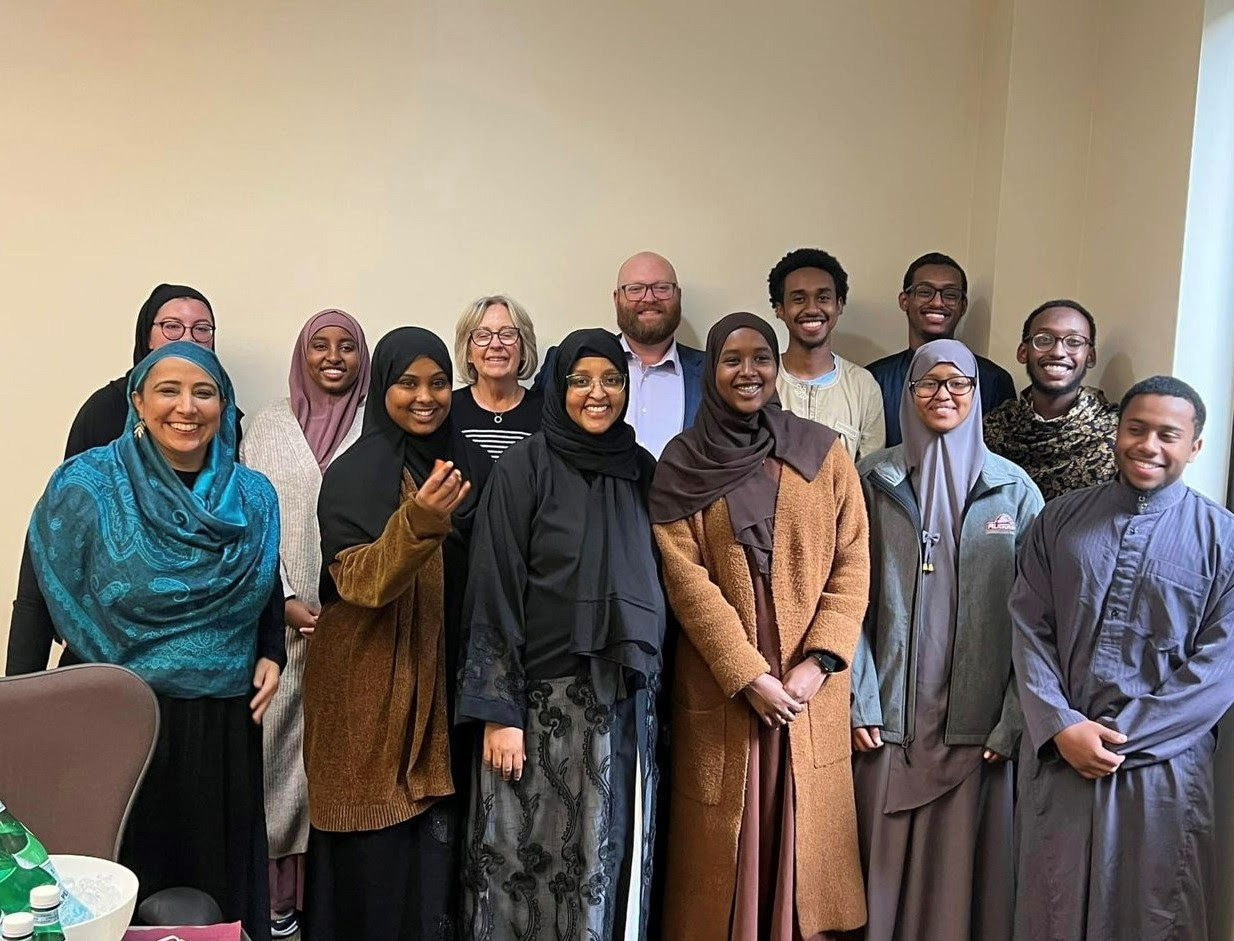
Augsburg's Muslim Student Association leaders with Karim El-Hibri, Nancy El-Hibri and Najeeba Syeed.
Augsburg’s Muslim Student Association leaders with Karim El-Hibri, Nancy El-Hibri and Najeeba Syeed

This October, by vote of the full faculty and then Board of Regents, I was incredibly honored to be appointed to the rank of Full Professor, with tenure and a university wide appointment which means I can work with all departments across campus. This demonstrates Augsburg鈥檚 commitment to the success of the Institute at all levels. We were so blessed to have Nancy and Karim E-Hibri visit us on campus this semester and inspire our students in so many ways. We are thankful for their involvement and support.

As our team works to build the Institute, we are focused on three elements of interfaith transformational work:听Care, Community, and Collaboration.

Our goal is to build on spiritual ethics of care within and across traditions of community to expand our collective capacity for compassion. We know we can only do this by creating intentional communities that bring us together, closer, and connected with a purpose for solving dire issues of our time. Ultimately, we want to collaborate in innovative ways to be the peacebuilders who are celebrated in so many holy scriptures and sacred teachings.

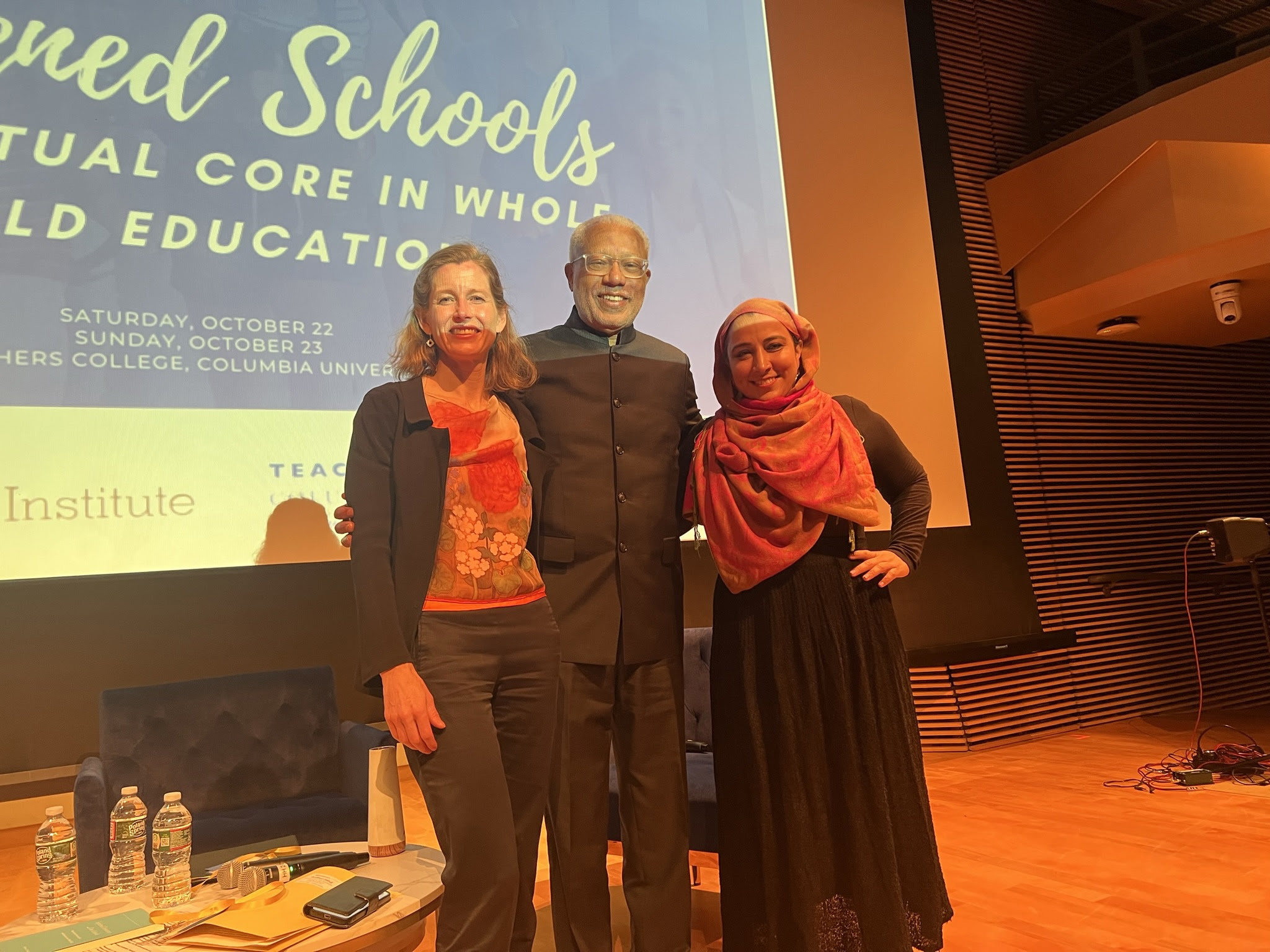
Najeeba and presenters at the National Spirituality in Education event.
Najeeba and presenters at the National Spirituality in Education event at Columbia University in New York on October 22.

This semester, we have already participated in seven public events. Some examples include:

Giving听a keynote on how to educate children K-12 in peace and environmental ethics听 for the National Conference on Spirituality in Education at Columbia University.
Lecturing听on care and community which will reach tens of thousands at the Annual Festival of Faiths, one of the largest annual interfaith events in the country.
Presenting听research on addressing mass incarceration from an interfaith perspective, using a restorative justice lens at a conference in Pasadena sponsored by Fuller Seminary and Interfaith America.

We have also been deeply involved with campus based programming, offering a well attended chapel session on interfaith vocation, guest lecturing in religion and communications courses on Augsburg鈥檚 campus, and continuing the Interfaith Scholars course which 12 campus leaders from diverse communities attend. We look forward to expanding campus based programming in collaboration with academic departments, campus ministries, student organizations, and off campus community partners.

This year, we have prioritized the current opioid crisis as a programmatic issue building on the programming done by our Institute and campus partners last year, led by Fardosa Hassan on our staff. This is the focus of our academic research and intervention. We have been convening campus partners to address the issue and to build an interfaith framing to expand faith leaders鈥 capacity to help stem a crisis which has cost more than 100,000 lives across the country and especially concentrated in communities who face other barriers. Our Institute will be publishing best practices and offering public educational programming听 that can be utilized nationally for communities who are experiencing parallel addiction crises impacting youth and young people.

We can only be successful if we partner with you, to see a world where people care more, build stronger communities and collaborate to end conditions of despair and violence.

Blessed are the peace makers!

With love and peace,
Najeeba Syeed

Interfaith at Augsburg Welcomes Najeeba Syeed

Najeeba Syeed

Interfaith at Augsburg is pleased to welcome Najeeba Syeed as the inaugural El-Hibri endowed chair and executive director of Interfaith at Augsburg. In this role, she will serve as a national ambassador for the interfaith movement and will partner with campus leaders as a change agent for interreligious learning and living. She also will serve as the faculty advisor for Augsburg鈥檚 Interfaith Scholars.

鈥淧rofessor Syeed is an experienced mediator, a publicly-engaged scholar, a passionate educator, and a seasoned organizational leader,鈥 said Augsburg President Paul C. Pribbenow. 鈥淭his appointment represents a crucial and exciting step forward in our commitment to enhancing interfaith leadership on campus and nationally.鈥

For more than two decades, Syeed has been a professor and expert practitioner in the fields of conflict resolution, mediation, and interfaith studies. An award-winning educator, she has taught extensively on interreligious education and published articles on faith and community-based conflict resolution, restorative justice, and interfaith just peacemaking. She previously served for 10 years as an associate professor at the Claremont School of Theology. She also held faculty positions at Starr King School for the Ministry and Chicago Theological Seminary, where she was most recently associate professor of Muslim and interreligious studies. She has served as the co-chair of the American Academy of Religion鈥檚 Religion and Politics Section and was a member of the Academy鈥檚 Religion, Social Conflict, and Peace Section.

Syeed also brings significant executive experience in organizations focused on conflict resolution in community, higher education, and government settings, including the Western Justice Center Foundation and the Asian Pacific American Dispute Resolution Center. In 2021, she served as chief of staff to Nithya Raman, the first Asian American woman elected to the Los Angeles city council. She holds a law degree from the Indiana University School of Law and a bachelor of science degree from Guilford College.

鈥淚 am honored to serve as the inaugural El-Hibri Chair and Executive Director of Interfaith at Augsburg. This is a unique opportunity to extend and amplify Augsburg鈥檚 remarkable interfaith work and to honor the generous and visionary commitment of the El-Hibri family, 鈥 said Syeed.

鈥淢y life鈥檚 work combines a commitment to scholarship, teaching, and community organizing,鈥 she added.听 鈥淟isten, learn, partner, and co-create is the process I utilize to lead and build with fellow faculty, administrators, students, community leaders, and stakeholders from around the globe.鈥

Interfaith engagement is a core aspect of Augsburg鈥檚 academic mission and reflects the religious and secular diversity of the campus and surrounding community. Interfaith at Augsburg: An Institute to Promote Interfaith Learning and Leadership was established in 2019 to further the belief that religious diversity can be a constructive force serving the common good. In 2021, a significant gift from Fuad and Nancy El-Hibri allowed for the creation of the El-Hibri endowed chair and executive directorship for the institute.

Syeed鈥檚 appointment helps to fulfill one of the goals of Augsburg150, the university鈥檚 sesquicentennial strategic plan, to advance the public purposes of an Augsburg education by enhancing interfaith leadership on campus and throughout the nation. Building on the strong foundation established by Bishop Mark S. Hanson, founding director, she will lead a strategic planning process that strengthens, integrates, and extends the Interfaith Institute鈥檚 work on campus and beyond.


Perspectives on the Opioid Crisis in the East African Community: Part 2

Interfaith at Augsburg and the Muslim Student Association present:

鈥淧erspectives on the Opioid Crisis in the East African Community: Part 2鈥

March 23, 2022 at 4:00 pm Central Time on Zoom


The East African community in the Twin Cities is experiencing a crisis of opioid addiction touching the lives of youth, young adults, and their families in our community. Two community leaders will share their perspectives and how they have responded to the crisis.

Mimi Sahlu 鈥 Mimi Sahlu is a small business owner. She is a community leader who helps others find resources. She is an activist and voice for East African women.

Abdirahman Mukhtar Abdirahman Mukhtar worked with the Confederation of Somali Communities in Minnesota, as a youth diversion coordinator and as the youth program manager at the Brian Coyle Center of Pillsbury United Communities, a hub for Somali immigrants. He strives to make a human connection with youth who are homeless, often alienated from their own community. He is the Founder and Executive Director of Daryeel Youth.听DARYEEL (which means “care” in Somali) is a volunteer-based Street Outreach effort to support East African youth.

Register in advance for this webinar:

https://augsburg.zoom.us/webinar/register/WN_PuElVX3XSICp4eSWLYQGxQ

After registering, you will receive a confirmation email containing information about joining the webinar.

Interfaith at Augsburg and the Muslim Student Association thank the Batalden Ethics Grant Program at Augsburg for sponsoring this event.

Interfaith Conversations on Racial Justice

Nov 5, 2021

The murder of George Floyd and the ensuing protests calling for racial justice have reverberated throughout Minnesota, around the country, and the world. How have these events disturbed and reoriented individual鈥檚 and society鈥檚 understanding of racial justice? What does this reckoning mean for people who espouse a religious or spiritual worldview? How does this moment provide an opportunity to reaffirm, rearticulate, or revise how religious and spiritual traditions work towards racial justice?

These videos invite practitioners from differing religious, spiritual, and secular perspectives to be in conversation about the issue of racial justice. During the conversations, these individuals find common ground as well as express ideas and insight that challenge one another to think and act differently.

Part 1


笔补谤迟颈肠颈辫补苍迟蝉:听Pooja Bastodkar,听Zenzile Isoke,听Tamim Saidi (Moderator),听Chris Stedman

Part 2


笔补谤迟颈肠颈辫补苍迟蝉:听Babette Chatman,听Wendy Goldberg,听KP Hong,听Tamim Saidi (Moderator)

Welcome to Chris Stedman as the Inter-Religious Resource Coordinator

Interfaith at Augsburg is pleased to announce that Chris Stedman 鈥08 will serve as Inter-Religious Resource Coordinator for the upcoming year. In this position, Chris will help Interfaith at Augsburg: An Institute to Promote Interreligious Learning and Leadership position itself to enhance interfaith leadership on campus and nationally, a goal identified in the Augsburg 150 strategic plan. His work will include the creation of teaching modules on 鈥渋nterreligious knowledge, skills, and leadership鈥 that can be used in courses such as Augsburg鈥檚 professional graduate degree programs. He also will assist in strengthening Augsburg鈥檚 Interfaith Ally training.听
Chris is not new to the Augsburg community. In addition to being an alumnus, he has served in a number of capacities since 2016, when he joined Augsburg鈥檚 Sabo Center for Democracy and Citizenship as a fellow. Following his time at the Sabo Center, Chris served for two years as an interfaith fellow at Augsburg. Last year, he joined the Department of Religion and Philosophy as an instructor, where he teaches multiple sections of Religion 200.

Outside of his work at Augsburg, Chris is a nationally-recognized writer, speaker, and activist. He is the author of 2020鈥檚 IRL (鈥淓ssential.鈥 鈥The AV Club) and 2012鈥檚 Faitheist (鈥淓xciting and boundary defying.鈥 鈥Houston Chronicle). Chris has also written for publications including The Guardian, The Atlantic, and The Washington Post. Most recently, his narrative podcast Unread (鈥淏est Podcasts of 2021.鈥 鈥Vulture) was released in June. It quickly found an audience around the world, including in Canada, where it hit number one on Apple Podcasts鈥檚 Society & Culture chart just a month after its premiere. Previously the founding director of the Yale Humanist Community and a fellow at Yale University, Chris also served as a humanist chaplain at Harvard University and a trainer and content developer for the Interfaith Youth Core. In recognition of his groundbreaking leadership in interfaith activism and humanist community building, Augsburg selected Chris for their annual First Decade Award in 2018.

Perspectives on the Opioid Crisis in the Somali Community


Thursday, September 30 at 4-5 pm

Webinar format hosted by 91成人 Events

Event sponsored by Interfaith at Augsburg and Muslim Student Association with thanks to the Batalden Ethics Grant


Please join us for a panel discussion with:

Imam Abdisalam Adam, Assistant Principal of Highland High School in St. Paul, member of the Fridley School Board; former Augsburg Interfaith Fellow

Cadnaan Deeq, former Augsburg student

Farhia Budul, CPRS, CPP, FPRS, Executive Director, Niyyah Recovery Initiative听

Niyyah Recovery Initiative (NRI) is the first Recovery Community Organization in the nation to provide culturally responsive peer recovery support, education, awareness and advocacy in the East African immigrant, refugee, and Muslim population in Minnesota.听

Description:

At a time when the local Somali community is facing a crisis of opioid addiction, we will hear the perspectives of a community leader and educator, an expert in culturally responsive peer recovery support, and a student. In addition to learning more about the crisis we will focus on ways religious communities, health care providers and Augsburg are responding and might collaborate in the future. There will be time for questions from participants.听

Registration:

Register in advance for this webinar:

https://augsburg.zoom.us/webinar/register/WN_lEW5MOKmTZqlCv-eLEEPxQ

After registering, you will receive a confirmation email containing information about joining the webinar.


Discerning our Moral Commitments Together: A Multifaith Conversation on Racial Justice and Human Dignity

Minnesota Multifaith Network (MnMN) is offering an interfaith convening called, “Discerning our Moral Commitments Together: A Multifaith Conversation on Racial Justice and Human Dignity” on听Thursday, June 17, 2021, from 11:00am to 1:00pm CDT. Held online, all faith leaders, interfaith organization leadership and volunteers, people of all faith backgrounds, those of no faith commitments, and everyone committed to the flourishing of all communities in Minnesota are invited to participate in a deep conversation about our shared moral commitments as we grapple with all the ways the pandemic and oppression is causing harm. Speakers and small group circles will help build connections for justice and contribute to deepening a growing multifaith network in Minnesota. Tickets are $10 each with a 50% discount for MnMN members. To become a member, visit MnMN’s website at听听and click “Membership.鈥澨鼵ontact听info@mnmultifaith.org听with questions.

  • MnMN’s Website:听
  • MnMN’s Facebook: @mnmultifaith |听听| #mnmultifaithnetwork

The Intersection of Religion and Science: A Conversation with Aisha Mohamed 鈥16


Date: March 2, 2021

Time: 4:00 – 5:00 pm

Zoom Webinar


You are invited to hear Aisha Mohamed 鈥16 explore the intersection of of religion and science as she shares her own experience of being a Muslim and a biology major at Augsburg. While at Augsburg she was active in MSA and was an Interfaith Scholar and now is a second year student at University of Minnesota Medical School. Aisha will explore ethical questions raised by the advances in science such as organ donation and stem cell research. Awareness of these ethical questions can create strong leaders in scientific and other fields while holding deep connection to their faith. Following Aisha鈥檚 presentation, two Augsburg students will give their responses and there will be time for questions from the audience.

Sponsored by:听 Interfaith Institute, MSA, and Stem Peer Mentorship and supported by a Bataldan Ethics Grant.

The is available on YouTube.

Neighbors Together in a Divided Nation: An Inter-religious Conversation

Date: January 26, 2021

Time: 4:00- 5:00 pm CST

Format: Zoom Webinar

Now available on .


The 91成人 Interfaith Institute invites students, faculty, staff, alumni and friends of ELCA Colleges and Universities (NECU) to join in reflecting upon how various religious and secular traditions call for our engagement in loving and serving the neighbor, working for healing, justice, peace and mercy, and the care of creation in a divided and often distrustful nation and world.


Farhan Latif, President of the El-Hibri Foundation, will moderate a conversation with:

  • Imam Makram El-Amin, Masjid An-Nur in Minneapolis
  • Professor Lori Brandt Hale, chair of 91成人鈥檚 Department of Religion and Philosophy
  • Rabbi Rabbi Arielle LeKach-Rosenberg, Assistant Rabbi, Shir Tikvah Congregation in Minneapolis

Following the presentations we will hear from student respondents, and there will be time for questions and conversation.


The is available on the Campus Ministry YouTube Channel.

About our presenters:

Farhan Latif is a philanthropic leader, social entrepreneur and cross sector mobilizer on minority inclusion.听 His work is inspired by democratic values and universal norms shared by faith traditions and his leadership has challenged global extremism and ideologically motivated hate.听 He is the President of the El-Hibri Foundation, focused on cross sector approaches to foster inclusion across religious and political divides. His work focuses on investing in Muslim leaders in partnership with allies to build capacity and resilience.

Imam Makram El-Amin has worked for听 more than two decades as a religious and community leader, firmly rooted in the principle of our inherent human dignity. In addition to his weekly teaching duties, Imam El-Amin leads Al Maa鈥檜un (Neighborly Needs) Community Outreach Services (almaauun.org) that addresses food insecurity, affordable housing, career services, and mentoring. A student of the late religious leader and scholar Imam W. Deen Mohammed, his thoughtful and moderate approach to Islam has afforded Imam El-Amin opportunities to share the stage with Bishop Desmond Tutu and the Dalai Lama. He was a delegate to a historic interfaith event in Rome with Pope John Paul II and member of an interfaith clergy delegation to the Holy Land.

Lori Brandt Hale is Professor and Chair of Religion and Philosophy at 91成人, where she has taught since 1998. She holds degrees from the University of Iowa, the University of Chicago Divinity School, and the University of Virginia. Brandt Hale has devoted her academic career both to teaching and to studying the life and legacy of Dietrich Bonhoeffer.

Rabbi Arielle LeKach-Rosenberg serves as Assistant Rabbi, with a focus on music, prayer and activism.听 She was ordained by the Rabbinical School of Hebrew College in June 2017.听 She spent her final two years of rabbinical school working as a full-time rabbinic fellow at B鈥檔ai Jeshurun in New York City, where she developed innovative initiatives for people of all ages and backgrounds to deepen their relationship with prayer, music and spiritual practice.听听